Showing posts with label War on Drugs. Show all posts

Friday, March 24, 2017

What You Need to Know About Las Vegas and Marijuana

What happens in Vegas stays in Vegas... unless there's a police record! Here's what you need to know about 420 in Sin City.


Many leading successful entrepreneurs--the multi-millionaires whose books and seminars people pay a ton of money for--all say you should get paid to do what you enjoy so your money works for you instead of you working for money.  In this spirit, I work a great side gig as a nightclub party host on the Las Vegas Strip.  

I have guests asking me random drug questions all the time.  I also see the occasional stoner on the Strip get taken away in handcuffs.  To avoid a ruined vacation and a string of legal problems, here's what you need to know about marijuana laws in Las Vegas and the State of Nevada. I answer the following questions: 

Is marijuana legal in Las Vegas?

Can people smoke weed on the Strip?

Where can people buy weed in Las Vegas?

Can I reek of weed in the club?

Find the answers to these questions at Potent.media

Wednesday, March 15, 2017

[Mini-podcast] GOP and Pot: What Happened to States' Rights?!


Sean Spicer warned that the Feds are coming after recreational marijuana and the DOJ threatened the Moapa Paiute Nation over the 2017 High Times Cannabis Cup, even though the Moapa Paiutes are a sovereign nation AND marijuana is legal in Nevada... Republicans, WHAT happened to states' rights?!

So far:
  1. Mexico is NOT paying for the wall, but maybe will someday through... tariffs?
  2. The GOP's ObamaCare Lite still has an individual mandate
  3. The meaning of states' rights has suddenly changed to what's convenient for Jeff Sessions

With Republican policies like these, who needs Democrats?!

Listen on Soundcloud

Monday, February 20, 2017

Anatomy of the Mexican State

Francisco “Pancho” Villa turned his criminal organization into an army and was warlord over Chihuahua until his death in 1923

Given the utter failure of the Mexican federal government to abide by its social contract to provide specific services to the large sectors of its population—i.e., education, health care, respect of civil liberties, protection of property, and most importantly, protection of life— coupled with the government’s failure to exercise sovereignty over territory firmly controlled by narco-warlords, indigenous insurgent groups, and self-defense militias, it’s reasonable to conclude that Mexico is a failing state.

Since the state still exists and provides services to some sectors of the population, it hasn’t failed altogether, but it certainly is in the process of failing.  More so since the erratic behavior of the Trump presidency and the announcement of the 20% wall tariff caused the peso to crumble.

Criminologist John P. Sullivan (of the Small Wars Journal) elaborates on the Mexican criminal insurgency; namely that the insurgency’s main goal is to gain autonomy and economic control over territory. By hollowing out the state and creating alternative states—in this case feudalistic fiefdoms ruled by narco-warlords through their narco-guerrilla armies—the criminal insurgency introduces a dual-state model.

Read more

Sunday, February 19, 2017

Alcohol Prohibition spawned Mexico’s oldest drug cartel [Updated for 2017]


Those old enough to remember Prohibition in the U.S. remember it as a controversial and violent era. The Eighteenth Amendment and Volstead Act, passed by Congress in 1919, prohibited the manufacture and sale of “intoxicating liquor” for recreational use. Prohibition took effect in January 1920, but its effects will still be felt in 2020.

LEGISLATING MORALITY IN AMERICA


The alcohol ban, long championed by the temperance movement, was enacted with the intention of simultaneously lowering the crime rates and social ills like alcoholism in the U.S. However, it’s often said that the road to Hell is paved with good intentions. Instead of solving problems, the great social experiment of alcohol prohibition wreaked havoc on communities nationwide.

A study of over 30 major US cities showed crime had risen by 24 percent between 1920 and 1921, including a 13 percent rise in homicides and 45 percent increase in substance addiction. Another unintended consequence was the major boost Prohibition provided for organized crime. This phenomenon was a matter of simple economics: Americans wanted to drink.

Following the Law of Supply and Demand, people from all walks of life created a demand for liquor and criminal organizations supplied that demand through the production and distribution of contraband liquor. These crime groups were willing and able to resort to the necessary corruption and violence against law enforcement and rival alcohol cartels in order to protect their lucrative trade.

Read more

Saturday, January 21, 2017

A Message to the Libertarian Party from Uncle Ruckus


"Now now now, I don't wanna hear no talk ‘bout making liberal America sane again from any of y’all dang ol' America hatin' Wesley Snipes tax rebels!  Donald Trump is the most libertarian public soyvant since White Jesus! 

Only reason any of y’all Murray Rothbard peace-on-earth dope-smokin’ hippie types hate this great man is ‘cause he wants to make America great again!  He’s actually filled out in his life what y’all unemployable Freedom! t-shirt-wearin’ basement-of-yo-momma’s-house podcast-blogging Libertarian delegates fear most: a job application. 

Well guess what: ain’t no Libertarians gonna get elected, so ya might as well work with the Grandest Old Party and other great libertarian men like Paul Ryan and Steve Bannon so we can get somethin’ done around here.

I thank God and His divine messenger Ronald Reagan for bringing us this incredible libertarian man who don’t give no damn 'bout cultural Marxist beta-cuck issues like savin’ the black man from going to jail for the rest of his life over weed.  He shoulda thought about that befo’ he broke the law!

Y’all wicked little godless reason-loving atheist commies better hope the greatest libertarian on the planet don’t use Immigration and Customs Enforcement to physically remove yo’ black-and-yellow asses back to Ancapistan, Mexico where y’all came from.  It’d soyve you right, and y’all 420 canna-bunnies can have all the gay Jew Nazi cakes you want!

All y’all Fedora neckbeard anarchists leave these nice Republicans alone, now, you hear?  Now git off muh roads!" 


--The Reverend Father Uncle Ruckus, no relation


* * *


Uncle Ruckus is the property of Aaron McGruder and Sony Pictures Television.  Image from YouTube.  In case you hadn't figured it out, this post is satire.

Friday, November 28, 2014

DON JON (a libertarian take on sex addiction and the media)


Joseph Gordon-Levitt is an amazingly talented actor.  He did such an excellent job writing, directing, and starring in Don Jon (2013) that I had to say a few things about it, even after all this time.

The premise of the movie is an eligible young bachelor, Jon (played by Gordon-Levitt), who is a notorious Casanova.  Throughout the movie he reiterates a list of things that are important to him: “my body, my pad, my ride, my family, my church, my boys, my girls, my porn.”

Jon is also addicted to porn to the point where he’s no longer satisfied with actual sex.  Jon meets Barbara (played by Scarlett Johansson), a beautiful young woman from an upper class family who falls in love with Jon.  Both want their relationship to work out, but both have a problem.

Jon’s porn addiction and constant viewing becomes a major thorn in Barbara’s side.  At the same time, Barbara is enamored with romance movies with predictable Hollywood happy endings.  Both partners’ consumption of their preferred media has given them severely unrealistic ideals on love and relationships.  Barbara wants the working-class Jon to be her Prince Charming while Jon wants the uptight Barbara to be his super-whore in the bedroom.

Needless to say, this is a recipe for disaster.

The ill-fated lovers’ breakup gives Jon the time and motivation he needs for some serious soul searching.  In meeting and eventually dating a widow named Esther (played by Julianne Moore), Jon comes to grip with his addiction and realizes he needs a lifestyle change to be free from his addiction and raise his quality of life.

This is a movie that hits home for a lot of people.  There are tens of millions of teenage boys and adult men looking at pornography at any moment of the day.  Like any other addictions, porn addiction can consume people and change their lives.  Yes, porn actors and actresses are typically voluntary agents utilizing their bodies to make a living in creating a product that men and women around the world voluntarily consume.  However, continuously watching porn objectifies men and women alike as sex objects.  It’s voluntarily produced and consumed, so it’s ultimately none of our business, but let’s just be real about these false images our primal subconscious would have us believe.

As we see in Don Jon, porn distorts men’s ideals on women, sex, and relationships.  It’s not only prevalent in porn, but in popular culture.  Think of all the music videos with scantily-clad women shaking their chests and asses.  Think of popular movies like American Pie, which give young boys ludicrous ideas of how amazing high school will be.  (Frankly, I’m still terribly disappointed that high school did not offer me the chance to get naked with a foreign exchange student, have guaranteed sex on prom night, or to hook up with a friend’s attractive mother.  I want my four years back!)

The same applies to media consumed by women.  While many women do reject the iconic image of the sexually empowered female in pop culture, they do often tend to cling to images depicted in The Notebook or 27 Dresses.  I can’t tell you how many women I’ve dated with whom it didn’t work out, all because they seriously expected me to come riding up on a white horse to take them to a million dollar house with two cars. On the flip side, I've lost count of how many relationships could have blossomed if the woman wasn't scarred by some jerk who treated her only as a sex object.

These unrealistic images on our electronic screens of the ideal man or woman are marketed and sold to people because those images are entertaining.  However, it’s always been up to We the People to figure out that fiction—a pretend series of events in an author-controlled environment—is not to be mistaken for reality. What so many people never realize is that life really does imitate art.  Art itself embellishes life, and people who consume one or another form of media often fail to realize that a true happy ending takes a hell of a lot of work, compromise, and self-improvement.

In my opinion, the healthiest way to approach to any relationship is for both partners to openly discuss and be on the same page about where they are in life, where they’re going, and where they want to be, both as individuals and as a couple.

What I especially love about this movie is the way it portrays human action.  We might not think of the romances depicted in the movie as economics, but economics is ultimately the study of human action.  Dr. Ninos Malek, lecturer of Learn Liberty’s “Sexonomics” seminar, would agree.

Economics plays a major part in dating and relationships.  When a woman expects a man to provide her with a home and a certain standard of living, she’s setting a major economic standard for the success of their relationship.  Likewise, when a man expects a woman to support him—or to be a stay-at-home wife and tend to his every whim—he sets a major economic standard for the success of their relationship.  In the latter scenario, the stay-at-home wife’s education or career becomes the opportunity cost for his happiness.  For Jon in the movie, his romantic and sexual relationships become the opportunity cost for his happiness—porn.

By the time Jon and Barbara break up, their relationship is a sunk cost.  However, this is where market self-regulation plays in.  This break up is a very difficult sunk cost for Jon to bear.  He made a bad investment and a series of bad decisions.  He’s faced with a choice to repeat those failures, or to correct his behavior in order to never go through that kind of heartache—or sexual dissatisfaction—again.

Jon chooses to renew his mind and change his lifestyle.  He breaks his porn addiction and leaves porn behind.  He continues taking his night college courses not because his (now ex-) girlfriend will put out, but because he chooses to create more opportunities for himself.  Instead of club hopping and bringing random women home for sex, Jon chooses to be in a relationship with the widow Esther, who’s older and from whom he can learn a lot.

Best of all, the nanny state is in no way involved in Jon’s transformation!  It was never necessary to "fine" or "tax" or jail the pornographer or the porn addict.  This isn’t entirely different from someone kicking their drug habit.

While many people may get court-ordered to Alcoholics Anonymous or Narcotics Anonymous, the ranks of those support groups are dominated by everyday people who made their own decision to get clean and voluntarily participate in the program.  They’re tired of letting people down, they know their lifestyle will be lethal if left ongoing, and they’re ready to try to rebuild their lives.

Like a recovering addict, Jon’s changes in behavior all result from social consequences.  His actions cost him a relationship.  He has to deal with the public scorn of women he hooked up with and then discarded.  He identified that these events are indicative of failure, and he wants to experience success.  Don Jon is about personal responsibility—a concept we libertarians hold in the highest esteem.

Being aware of economics as human action made this movie even more enjoyable to me because I was able to see economics happening and unfolding right before my eyes.  It doesn’t simply include money and graphs.  Economics is all around us, not only in the way we spend our money, but in the way we spend our time and in the company we keep.


* * *


Don Jon movie promotional images courtesy of DonJonMovie.tumblr.com

Monday, October 6, 2014

Criminal Insurgency: Gang Members as Warfighters, Libertarian Solutions


The war in Mexico between paramilitary drug-trafficking organizations and the government has shown the world how warfare is evolving.  With market-oriented technological advances, it’s possible for wealthy players to raise private armies.  It’s equally possible, and easy, for individuals to wage terrorist campaigns.


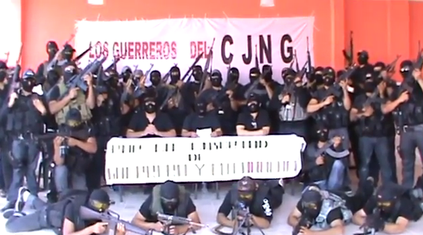
Jalisco New Generations Cartel declares war on the Knights Templar Cartel.
Nowadays, all it requires to be an insurgent is an AK-47, some explosives, and a laptop or tablet.  The words “terrorist” and “insurgent” are becoming synonymous as various “rebel” groups adopt both tactics at will.  Wars are being increasingly fought by non-state groups. Two examples are the separatist and nationalist militias in Ukraine, and the Kurdish guerrillas fighting ISIS in Syrian and Iraqi Kurdistan. Furthermore, the line between street gangs and organized crime syndicates is blurring.


The Mexican Drug War and other recent conflicts in show that gangs and highly organized criminal groups can also be rebel soldiers.


Take the Mexican cartels—commonly called drug gangs—once merely organized crime groups with street gang enforcers, now evolved into paramilitary organizations fighting the state and fighting rival paramilitary groups.  Their war has killed over 140,000 people in a decade.  This is called criminal insurgency.


Gang violence and organized crime activities have skyrocketed across Latin America, especially in Nicaragua, Honduras, and El Salvador.  The main combatants in the Central American gang wars are Mara Salvatrucha [MS-13] and Barrio 18 [18th Street or M-18].  Both transnational gangs serve as auxiliaries for opposing Mexican cartels. Their hired services include distribution, shipping, and armed enforcement operations.  Street gangs all over Mexico also work for one or another paramilitary drug-trafficking organization.


The ongoing civil war in Mexico—including its spillover across Latin America—is not the first instance of gangs and organized criminal groups fighting in modern wars.  Take the following examples:


  • In Mexico, 1910, Pancho Villa turned his bandit gang into a guerrilla army.
  • In China, bandit and warlord armies were absorbed into the Peoples Liberation Army in their fight against the Nanjing government.
  • The Vietnamese organized crime network Bin Xuyen openly fought the Saigon government and was absorbed into the Viet Cong.
  • Bandits and pirates joined demobilized anti-communist armies who formed paramilitary drug-trafficking organizations in Asia’s Golden Triangle.
  • Neighborhood gangs in Lebanon became overnight militias engaged in sectarian fighting.
  • In Colombia, the drug cartels partnered with the communist guerrillas to traffic drugs and fight the government.
  • The Iraqi insurgency in Fallujah included organized crime groups.
  • Today, the Taliban is financed in part by Afghan drug lords.


MS-13 foot soldier with a machine pistol
The United States has its own gang problem. Hundreds of thousands of people are members of local, regional, and national gangs.  According to Bunker and Sullivan, third-generation gangs (founded two generations ago) have the membership and logistical capability to resist the state.  Rather than battle over petty turf like first-generation local gangs, third-generation gangs have built up international trading networks, corporate-like hierarchies, and armed foot soldiers adequate for sustainable criminal insurgency.


Given the growing numbers, logistical capabilities, and sophistication of transnational gangs and local affiliates in the United States, alongside the growing numbers and militarization of America’s law enforcement agencies, it’s not unreasonable to suppose that a low-level armed conflict might arise between gangs and law enforcement agencies.  If a low-level armed conflict ensues, there is always the possibility of escalation.


There are libertarian solutions to alleviate a credible threat to national security like the one described above.


First, the Second Amendment must be respected by all levels of government in the United States.


Statistics have repeatedly shown areas with less restricted gun laws average less violent crime than areas under strict gun control.  The police can’t be everywhere, nor would free people want them everywhere, so the only solution for self-defense against gang violence is the right for citizens to bear arms.


Take Chicago, for example.  The city with some of the strictest gun control laws in the country is also the city with the highest murder rate in the country.  The majority of the 2014 Chicago murders were gang shootings.  Too many of those killed were bystanders, not participants in the violence.  The people of Chicago deserve to protect their persons, families, and communities.


Second, America’s prison system must shrink.


Prisons are illicit trading centers and recruiting centers for gangs at all levels.  As of 2008, 90.7% of federal prisoners were incarcerated for non-violent offenses.  As of 2011, 50% of federal prisoners were in for drug-related convictions.  Such a high level of non-violent offenders would prompt expanded parole, with a work-reparations plan if necessary.  Otherwise, non-violent offenders become “criminalized” by the violent prison culture.


Third, drug crimes constitute nearly half of federal inmates, the majority of them nonviolent; this points to one solution: end the federal war on drugs.


Better yet, legalize the victimless “crimes” for which nonviolent offenders are incarcerated.  Drugs, gambling, and prostitution are booming industries, and their illegality guarantees their domination by organized crime.  Rather than enabling racketeering for criminals, why not turn these industries over to law-abiding entrepreneurs?  Especially when their success must come from quality products and customer service, not coercion or monopoly through violence.


Homeland Security agents disembark from a MRAP vehicle
Fourth, law enforcement agencies must be demilitarized. There is no reason compatible with liberty for the Department of Agriculture to have submachine guns, nor is there any reason for local police departments to have armored personnel carriers.  If the public is faced with a military-grade threat, the states have National Guards who can respond appropriately .


Demilitarization of law enforcement reduces the chances of confrontation between law enforcement and criminal networks. Through legalizing drugs and other outlawed vices, major income sources leave the criminal underground for the free market.  By shrinking the prison system, gangs have far fewer recruit for their networks as non-violent offenders are paroled.


Criminal insurgency is a credible future threat to America's national security.  Through abiding by free market principles nationwide, and strict self-defense in times of emergency, this threat can be avoided and neutralized peacefully.


* * *


JNGC image taken from a YouTube screenshot from Wikimedia Commons via Fair Use.  MS-13 photo courtesy of the "Shooting From the Lip" Wordpress blog. Homeland Security paramilitary agents photo by DHS, obtained from "Stripers Online" forum, and in the public domain.

Tuesday, June 3, 2014

Civil War in Mexico (the Mexican drug war)

High school aged kids from Juarez would take part in--and be victim of--massacres that shocked the world.

Mexican Marines operating against paramilitary Los Zetas
Hello, fellow libertarians and aspiring libertarians!

Many of you expressed interest on Facebook and Twitter in my undergrad thesis on the Mexican drug war, which I argue is a multisided civil war and a modern war.  The paper is complete, was submitted two months ago, I presented it at three conferences, and I'm graduating in two weeks.  Hoorah!

I recently polished and expanded the paper (in order for it to be above the quality of Finals Season, i.e., great rush, much caffeine, little sleep). Once I was happy with it, I submitted it for publication and I sure hope they accept it!

In the meantime, I uploaded my unpublished paper as a working paper on Academia.edu.  If you're interested in a 50+ page academic paper on people killing each other in creative ways, then you'll enjoy it. The title is "CIVIL WAR IN MEXICO: Re-Examining Armed Conflict and Criminal Insurgency." You can download the PDF or read it online on my Academia profile.

P.S. I cited Ron Paul and Murray Rothbard as academic sources.  Winning!!!


* * *


Photo by Borderland Bear Reporter Buggs via CC BY-SA 2.5 license. Image obtained from Wikimedia Commons.

Monday, February 10, 2014

[VIDEO] Rise of the Mexican Self-Defense Militias

Friday, January 31 I was lucky enough to be a guest on the "Last Voice For Liberty/ Friday Night Live" Super Show with Dennis Ford and my other liberty movement friends.  I talked about the civil war in Mexico (a.k.a. the Mexican drug war) and what my country has to do with it.  I talked for an HOUR and we barely scratched the surface of vital information!

You can listen to the full segment here (I'm in the second hour) or enjoy the following excerpt with images, about the citizens militias popping up all over Mexico!  Now THESE people know the true meaning of DON'T TREAD ON ME!

--ZF


Images used in the video courtesy of the Community Police (citizen militias) of Michoacan and Guerrero.

Friday, January 3, 2014

FIVE LIBERTARIAN IDEAS #5 - Mexican self-defense militias, Disney movies, radical Islam, etc.


Weed clinic vs. drug cartel
Before medical marijuana was legalized in Arizona, underground medical clinics had little choice but to buy the drug in bulk from the Sinaloa cartel. When the drug was legalized for medicinal use, requiring clinics to grow their own supply, many clinic operators were assaulted and some murdered. This means that legalization of the drug in the U.S. is a threat to the cartels' finances and their authority. Let's peacefully neuter these terrorist organizations! –12/24

Christmas, Christianity, Free Will
Free will is a cornerstone of being human. Freedom of choice is a cornerstone of libertarianism. Christmas is one of my two favorite holidays. Today we observe the birth of One who came into the world to give us a choice: whether we would move forward or be left behind. Regardless of one's beliefs, we all have a choice, and I utilized my freedom to make MY choice. Merry Christmas! –12/25

Mexico’s self-defense militias
Murray Rothbard describes the militiamen at Concord as fighting a guerrilla war of national liberation. In Mexico's current civil war, towns are rising up to fight their oppressors. They've defied gun control, declared their communities autonomous, and replaced the corrupt militarized police with local militias. No group of people better represents libertarian national defense and self-defense than these patriots. –12/26

Grimm’s vs. Disney
I wish America grew up on Grimm's fairy tales instead of Disney. Our society has UNREALISTIC expectations of living happily ever after and everything being magical. Women want to be treated like princesses. Instead, I think men ought to treat women like queens... A queen ranks above a common man, but like queens, women must be poised, strong, and capable of being leaders. –12/27

Islam, terrorism, drug prohibition
Muslims are not a threat to our national security--RADICAL Islam is. The difference between Muslims and Al Qaeda is the same difference between Christians and the Ku Klux Klan. But the BIGGEST threat to our national security is paramilitary drug cartels in Mexico forging alliances with American street and prison gangs. The reason they have so much power is the same reason American gangsters grew powerful in the 1920s: GOVERNMENT PROHIBITION. –12/28


* * *


UPOEG photo courtesy of enca dot com.