Showing posts with label Civil War. Show all posts

Sunday, May 24, 2015

'Tangerines' anti-war movie review

I had the opportunity to catch a screening of a well-reviewed foreign film, Tangerines (2015).  Tangerines tells the story of an Estonian farmer, Ivo, in wartime Abkhazia (northwest Georgia, between Russia and Turkey).  Ivo doesn’t care about the war or to take sides; all he wants is to harvest his crop of tangerines and be left alone.

The remote mountain village Ivo shares with his business partner, Margus, is exquisitely beautiful.   It could be the scene on the back of a postcard.  The village is also a ghost town, as the inhabitants fled in the early days of the war.  To Ivo’s horror, the war comes to his doorstep only days before the tangerines are to be harvested!

After a loud firefight rages past the village, Ivo and Margus check the battlefield for survivors.  There are two:  a Chechen (pro-Russian) mercenary and a Georgian soldier.  Both are badly wounded and require medical care, and both are taken to Ivo’s house where they begin their recuperation.   Ivo and Margus must then find a way to keep the two warfighters from killing each other while they heal.  They must also hide one or the other from enemy troops, depending on what nation’s army or militia passes through the contested area.  As if they didn’t have enough problems, they still need to find a way to harvest an entire crop of ripe tangerines!

This movie is delightful and thought-provoking in a variety of ways.  For starters, there’s not a whole lot of war violence in this movie.  The violence and the impact of the war are mostly implied, so this film is heavily performance-based.  I like the lead actor’s performance as Ivo; he’s a stern grandfather who imposes his authority in his own house, but will also surprise people with a subtle-yet-irreverent joke.  Ivo comes across as James Stewart in Shenandoah, but with a touch of Denis Leary in The Ref.

Next are Ahmed, the Chechen mercenary, and Niko, the Georgian soldier.  Ahmed is an extroverted, often loud-mouthed warrior who often vocalizes his intent to kill Niko.  Niko, an introverted intellectual, cites Ahmed’s ignorance and invites him to follow up on his threats.  Both characters grow as the plot unfolds.

For added context to the film, the story takes place during the Abkhaz War of 1992-93.  There were a series of small wars across Eastern Europe and Northwest Asia once the Soviet Union disintegrated.  Apart from countries seceding from the nonexistent Soviet Union, other nations and “autonomous” republics within former Soviet republics also tried to secede.  Abkhazia today is a de facto independent state and partly occupied by Russia, though it’s internationally recognized as a part of Georgia.

Another element of truth is that the film presents the intermingling of ethnic groups.  Aslan is a white, blue-eyed Chechen Muslim whereas his comrades have Middle Eastern features.  Other Europeans are seen with mixed features as well.  The absurdity of the ethnic cleansing that happened in this war is reflected in the film when, more than once, different soldiers and militiamen from various nations’ troops have to ask what someone’s ethnic background is.  The jackbooted thugs asking can’t tell, because most characters in the film look the same and speak the same language, despite being ethnically different.

Abkhazian war veterans and their families march in a parade.
One sad irony that most American viewers won’t pick up lies in Ahmed’s political loyalties.  Abkhazia’s war of independence was turned into a proxy war for Russia, one of several in the 1990s by which the Russian government hoped to weaken its newly independent constituent republics.  Though a mercenary, Aslan is aligned with Russia and believes in Abkhazia’s right to secede from Georgia.

However, Ahmed is also a devout Muslim, like most Chechen people.  But like most Russian mercenaries in the 1990s, he is probably a veteran of the Soviet Army.  The year following the end of the Abkhaz War, 1994, was the start of Chechnya’s wars of independence.  Chechens heavily rallied around Islam and their war against the Russian government became a holy war.  This leaves the viewer to wonder, should Ahmed survive the Abkhaz War, which side would he choose in 1994: Russia or Chechnya?

I truly appreciated the libertarian message entrenched in the movie.  Apart from the obvious theme that uses war to appeal to the viewer’s humanity, the film also stresses peace and commerce.  Throughout the movie, both Ivo and Margus lament the war and how it’s taken all the men away from productive work, like harvesting their tangerines for an daily wage.  Ivo and Margus repeatedly try to recruit militiamen from any side to work as day laborers in the orchard.  Their focus on peace, unhampered commerce, and ignoring nationality to increase economic cooperation, is a vivid reflection of the pillars of Austrian economics.


Tangerines is a movie that gets it right.  It's also a valuable tool for libertarians to touch minds in eastern Europe.


* * *


Tangerines movie poster courtesy of Wikimedia Commons and used according to Fair Use. Abkhazian parade picture by 'Apsuwara' and used via CC BY-SA 3.0 license, and was obtained from Wikimedia Commons.

Tuesday, December 9, 2014

Underground Punk Rock and Spontaneous Order—The Boredom, Dispatch 4

I woke up as the sun’s rays began to brighten the inside of a beat up Ford F250.  I was folded up in the back seat while Midshipman occupied the front.  He looked like a bear coming out of hibernation.  We both climbed out of the truck and quickly ran out of the shade and into the warmth of the sun.

We got to the edge of the lower meadow when we realized the sunrise over the mountain valley was breathtaking.  Midshipman and I split my last two cigarettes and stood smoking in silence as we took in the sun.  It was a deeply reassuring feeling becoming one with nature.

This was Sunday morning—Day 10 of The Boredom.

After an indeterminate amount of time we piled into the truck and took a rocky dirt road over to the upper meadow, a mile or two away.  There was a turnout on the road, trimmed by a ranch-style minimal wood fence that fed into a path.  At the end of the path which took me a short way into the meadow stood a lone cabin.


The cabin was built there in 1859.  William F. Holcomb and Ben Choteau, prospectors from Bear Valley, found gold in 1860 while tracking a bear in the next valley north.  The discovery triggered a gold rush in San Bernardino County and by 1861 “Belleville” (the town named after the first child born in the valley).  However, the boom quickly busted and Belleville was virtually a ghost town by 1864, and literally a ghost town by 1870.  I suspect the folks there got caught up in the drama of the Civil War, which even affected California.

Breakfast consisted of leftover pizza from the night before—Midshipman heated up over the engine.  We ate our pizza and let the warm sun and cold wind confuse and torture our bodies.  Despite the elements being harsh up there, it was invigorating just being exposed to them.  By 10:30 we began the bumpy trek down the mountain.

What a hell of a weekend it had been!

Monday, Day 11, was largely uneventful.  I wrote and I worked on manuscripts, and I made excuses not to go to the gym.  I put a metaphorical gun to my own head and wrote the third dispatch for The Boredom, which was published to the Rants blog later that evening.

I did attend my weekly Civil Air Patrol squadron meeting—the first Monday of the month is always Commander’s Call and awards ceremony.  I took a ton of photos of CAP members just going about their business.

Chartered by Congress, Civil Air Patrol is the U.S. Air Force Auxiliary, a civilian volunteer organization authorized to wear paramilitary uniforms and carry out search-and-rescue and disaster relief missions on behalf of the Air Force.  I’ve been an auxiliary airman for three and a half years, on top of my two years as a military contractor and seven years in the state guard.

I spent the morning of Day 12, Tuesday, editing and preparing the photos from Commander’s Call for uploading to the squadron Facebook fan page.  I spent a few solid hours working on manuscripts and an hour or two slaying orcs on The Lord of the Rings Online.  Good times!  Later that evening I prepared the thirtieth installment of Five Libertarian Ideas for next-day publication on the Rants blog.

Wednesday/Day 13 I went to the gym and worked out like a fiend.  My body and mind equally needed it.  While doing cardio on the machines I started a new book—War Is a Force That Gives Us Meaning, by Chris Hedges—as if I needed any more books to read.  I still have a pile I either haven’t started or haven’t finished.  Each and every one is outstanding, and I can’t put either of them down, at least until I find the next one.

That night I linked up with one of my close friends, Aqua Bat.  He’s been a friend since childhood, from Scouting, and we really started hanging out a lot after high school ended.  Aqua Bat is an interesting character.  He’s a new-school stoner with a love for punk and ska music.  His preference for Converse shoes, shorts, and brightly knitted Baja jackets and beanies give him the look of an orphan rescued and raised by a Peruvian flute band.

We drove down into a seedy-looking industrial area of lower Pomona—we were south of Holt Avenue and east of the 71.  Our objective was the VLHS warehouse, an amazing little place tucked away in between shipping warehouses and welding garages, far out of ear shot in its location at this time of night.  It’s the ideal place to hold a concert, throw a party, get wild, you name it!

VLHS—named after the show producer’s high school—is DIY (do-it-yourself) punk at its finest.  As a matter of fact, this is full-on underground punk rock.  There are no permits, no insurance, no mass-posted flyers letting anyone know the shows at this location are approved and open to the public.  There is only a private lease paid in cash between the show producers and the property owner.  The shows are promoted by word of mouth and Facebook, to a very limited extent.

The shows at VLHS are technically illegal.  We don’t care.  For us it’s about freedom of assembly, freedom of expression, and voluntary association.  Spontaneous order happens every night there’s a show at VLHS.  It’s BYOB, and everyone’s either holding a beer can, a bottle of liquor, cigarettes (for your non-drinkers), and the harder stuff people are encouraged to do inside their car or on the other side of the building.

The “donation” is paid at the door, and all participants are aware that this is private property.  Moreover, the DIY punk rockers and supporters here police themselves.  Serious drama involves the cops, and the police typically frown on untaxed, unpermitted, unregulated concerts.  So everyone solves problems between themselves and no drama ensues.

Aqua Bat and I hadn’t been to a VLHS show in nearly a year. It felt good to be back among familiar sounds and familiar faces.  I love punk rock, not just the juxtaposed simplicities and complexities hidden in the chords and lyrics, but for its spirit of rebellion and a determination of individuals not to be ruled.  Not bad for a Wednesday night!

Thursday was a blur—I went to bed late on Wednesday night and paid for it with a late morning.  I shambled off to the gym, got in a decent work out, and reflected on Chris Hedges’ philosophical essays on war.

Day 15, Friday, I spent most of the day fine-tooth combing through some texts on the Vietnam War for a writing project that’s been slowly developing over the last few months. I’m nowhere near ready to announce this, but this project will be one of my proudest scholarly achievements. 

Friday night saw Aqua Bat and I return for another show at VLHS.  Punk rock women are some of the most attractive on the planet.  There’s just something about the way they pull off leather and black without going full Goth  Then their off-beat hair (usually dark with a neon highlight or two), and the whole mysterious persona they wear along with their torn jeans…  Life is good.

Day 16, Saturday was an obnoxiously early start.  It wasn't yet 6 AM as I tore myself away from sleep and started shuffling into my Army Combat Uniform.  I picked up a large jerky stick, a Powerade, and a Red Bull and made the 45-minute commute to the National Guard armory I drill at once a month.


It was December drill, cut short by the usual annual family-friendly barbeque banquet.  The banquet was at noon, so morning-time had a lot of ridiculous standing around.  Whatever.  I was at all the places I needed to be and I got my tasks done.  Better yet, I had time to coach some junior enlisted soldiers about a few career matters involving the uniform.  I find it ironic as hell that the majority of soldiers in the state guard are in their 40s and 50s—it’s Title 32 militia, after all.  Then here I am, 25 years old, outranking dozens of people.  I guess I really have been in 7 years!


* * *


All photos used in this post are the property of the author.

Wednesday, November 26, 2014

Books, Heartbreak, and Alcohol Drama (The Boredom—Week 1, Part 1)


Thank you for reading more about my quest to do meaningful, productive things while I kill time before returning to my amazing job that I love.

Day 3.  Sunday had a productive start.  Not only did I open both eyes, but I even managed to crawl out of bed and slide into some clothes that were probably clean.  I decided to press my winning streak by writing some more—the more I write, the more I can publish and share with the world.

I sat down for a good minute and I wrote a libertarian review of The Hunger Games: Mockingjay Part 1.  The review primarily focuses on guerrilla warfare in Mockingjay and ties that imagery into Murray Rothbard’s writings on guerrilla warfare in the American Revolutionary War (Rothbard, Conceived in Liberty, Vol. IV, ch. 3).  This one has been one of my more highly trafficked articles of late, so I’m pleased at the exposure it’s getting.

I burst out of my creative trance, hightailed it through the shower and picked up both of my teenage nephews at noon.  I like to spend as much time with those boys as possible, especially since their old man took off years ago.  It’s good bonding time, plus I get to talk to them about things that matter.

My nephews and I enjoy seeing movies together.  I took them both to see the awful Red Dawn remake, and the younger one accompanied me to Frankenstein and The Bride of Frankenstein on the big screen.  This time, I took the boys to see Fury before it’s out of theaters.  They really wanted to see it, I certainly didn’t mind seeing it again, and I figured this is a good way to round of the last two WW2 movies I’d showed them: Schindler’s List and Saving Private Ryan.

I don’t know what it is about this generation of kids, but they’re way too fond of Holocaust jokes and Call of Duty has made them all think they know what war is.  Basically these intense, gut-wrenching, realistic movies have given them an idea of what violence and suffering really look like.  They’re great teaching aides and Fury was a great finishing touch, with its depiction of Allied misconduct in the war while it still praises the overall heroism and courage of the Greatest Generation.

The boys enjoyed the movie and got something out of it.

Sunday night I got together with some good friends for a backyard bonfire.  Not gonna lie, I take great pride in the fact that I can build a fire in this age of technology.  I figure if some natural disaster happens and the power grid goes out, a lot of people are going to suffer needlessly.  Other than that, knowing how to build a fire is super nice for relaxing outside in cold weather.


Day 4, Monday, was largely uneventful.  I wrote a bit before working on manuscripts for near-future publications.

In 2015 I plan on launching an independent publishing house.  This won’t be like Political Spectrum Publishing.  I’m very proud of PSP and the amazing book it produced—VOICES OF REVOLUTION: Americans Speak Out for Ron Paul.  However, after the Voices book was released and it became increasingly clear Ron Paul wouldn’t be the Republican nominee, the whole train lost steam.  Also, real-life commitments got in the way (such as other campaigns I worked, my job, a toxic relationship, and of course, finishing college).

PSP was a great learning experience, but that was the worst time in my life to have tried—or half-assed—to start a business.

Realistically, a startup business is more like a newborn baby than a Giga Pet—if you don’t know what those are, thanks for making me feel old!

Therefore, my new publishing house is going to be something I can show my own father, look him in the eye, and be proud.  Hey, if I’m not proud to present something to the man I respect most, what business do I have presenting it to the world and even asking for their money?

I’m tentatively calling it The American Liberty Library (ALL). The name is catchy yet meaningful—the focus will be both fiction and nonfiction books that simultaneously entertain or engage and promote libertarian ideas.  Other than forming my business model and plan, I’ve actually been preparing product, hence my working on manuscripts.

Of course the American Liberty Library will be my preferred method of publishing my own books—almost done with #3!—but that won’t be all.  It’ll include some essential classics like Tocqueville’s Democracy in America and the writings of Bastiat, but I’ve also been doing hours of searching for dormant manuscripts.  There are many remarkable books on liberty and in sync with libertarian ideas, but they’ve been lost to time and are in the public domain.  I think it’s time some of these forgotten classics made a comeback!

Tuesday, Day 5 of the Boredom, was an interesting day to say the least!

Ever since we saw each other Friday night, the special gal from Rancho was been acting very strange toward me.  Tuesday morning I found out what I needed to know.  I wish she had just been honest with me instead of getting my hopes up, but it’s better to know anyhow.  Now I don’t have to wonder.

I went to the gym and had a great workout to get my mind off of things.  Then I swung by In ‘N’ Out for a protein-style Double-Double and animal-style fries, washing it all down with a cold Dr. Pepper.  It was a feast fit for kings!

I finished digitally restoring the manuscript for Harold Frederic’s 1893 novel, The Copperhead.  Some of you may be familiar with the novel’s movie adaptation, Copperhead, by Gettysburg director Ronald F. Maxwell.  It’s a well-written novel and has a totally different ending than its film adaptation, so this is good!

That evening, I picked up some friends for what was to be an amazing night out.  For months, whenever I’m in town, I’ve headed up to the Saddleback Inn at Lake Arrowhead, California for karaoke and fun times.  The people there are always really cool and there’s never drama, only people trying to enjoy themselves.

Unfortunately, it was dead that night.  I’ve never seen this normally-cracking place so entirely dismally dead.  Therefore, one of my friends decided it wasn’t going to be a good night.  He got ridiculously drunk—we hadn’t even been there an hour before he was smashed—and he ended up getting belligerent and talking a ton of trash to the bartenders.

Needless to say, the owner of the establishment personally asked us to get him the hell out of there.  Basically, I’d driven everyone there for a solid one-hour each way drive, for us to be home by 11.  That night was a loss.  I was really disappointed that one of my closest friends could make such an ass of himself in public and embarrass me in front of people I respect at one of my favorite hangout spots.  They were all cool about it, they knew he was drunk, etc., but the company you keep is the name you carry, and they’re going to remember that I brought that guy.


Day 6, Wednesday, I woke up a little later than planned.  I emailed a client regarding a side job, and then did what was unpleasant, but necessary.  I called the girl from Rancho to give the breakup talk.  She didn’t answer; I didn’t expect her to.  So I left a long voice mail balancing a list of grievances with respect and the promise that I would neither cause her any drama nor stand in the way of her happiness.

So here I am.  Now, I’m off to go do something useful.  Check back in a few days for another update on The Boredom.


* * *


Mockingjay Part 1 art is the property of Lionsgate films and other respective owners and stakeholders, used here according to Fair Use laws for the promotion of the movie. Copperhead movie poster is the property of Swordspoint Productions, Brainstorm Media, and other respective owners and stakeholders, used here according to Fair Use laws.

Sunday, November 23, 2014

Guerrilla Warfare in 'Hunger Games: Mockingjay Part 1' (libertarian film review)

WARNING
This libertarian movie review contains SPOILERS.
These spoilers DO NOT give away the plot, but they do reveal certain things viewers will see in the movie.
You’ve been warned.

The Hunger Games: Mockingjay Part 1, starring Jennifer Lawrence, is a thrilling action/sci-fi film about a revolutionary war in a dystopian future.  Like its predecessors in the Hunger Games Saga, Mockingjay Part 1 is remarkably well made and will keep viewers glued to their seats.  However, the “Part 1” in the title should clue people in to the fact that the movie is a total cliffhanger.

The setting itself hardly needs to be analyzed to find the striking libertarian imagery.  In Panem we see an oppressed people living and dying under the yoke of a totalitarian government—a massive surveillance and police state.  First there is Katniss Everdeen’s individual defiance against the state through seizing freedom of speech and expression in the Hunger Games.  In the second installment, we see the birth pangs of the revolution amidst the Quarter Quell Games.  In the third and fourth installments—Mockingjay parts 1 and 2—we see the revolution become a brutal civil war.

Because the film is divided into two parts of two hours each, the producers could afford to take their time telling the story.  Therefore, the exposition is slow and the plot is slower to unfold.  This first half is less about the revolutionary war to overthrow the Capital than it is about Katniss Everdeen’s transformation from stunned tribute into the Mockingjay, the face of the revolution.

One of the benefits of slower, longer movies is the increase in time spent on showing depth and detail in the story, characters, and setting.  We get a heavier taste of Katniss’ post-traumatic stress following the games, as well as new challenges to her fragile sanity as the war begins to take its toll on loved ones.  We also have time to see the general way of life in the rebel capital, District 13.  These glimpses create an authentic look and feel of wartime, combining images that cross World War II with the Fallout video game series.

Even more intriguing is Katniss’ interaction with President Coin, the rebel head-of-state played by Julianne Moore. Coin’s stirring speeches to her soldiers and their Spartan, in-unison responses invoke mental images of the post-World War II archetypal dictator, fist high in the air, riling up the troops.  This causes viewers to question whether the rebel cause is a just cause—after all, replacing one police state with another is hardly an improvement.  Phillip Seymour Hoffman also adds a good performance that complements both Lawrence’s and Moore’s.  This movie is one of the last times we’ll see Hoffman’s face on the big screen.


Moving past the gritty details of character and exposition, there is one element of the on-screen revolutionary warfare that intrigues me.  We get to see several glimpses of oppressed civilians rise up, with or without weapons, and fight the Capital’s “peacekeepers” (jackbooted thug troops clad in white).  In the lumber workers’ IED attack on the peacekeepers and the hydro-engineers’ destruction of the dam, the viewer is looking at guerrilla warfare in action.

Murray Rothbard writes about guerrilla warfare as the most libertarian way to wage a just war for a just cause.  In analyzing the American militia’s tactics and actions at Lexington and Concord, Rothbard says:

“In brief, a guerrilla war would be the libertarian way to fight a war fully consistent with the American revolutionary ideals of liberty and equality of rights, and, therefore, the only way to achieve the libertarian goals of the Revolution.  A European style, orthodox war would be heavily statist, and would inevitably lead to the resumption of the very statism—the taxes, the restrictions, the bureaucracy—which the colonists were waging the revolution to escape.

“What is more, guerrilla war would be enormously more effective; for that is the way any subjugated people—not only libertarians—can fight against a better-armed, but hated foe.  The efficiency of guerrilla fighting as against European warfare had not only been demonstrated in the unbroken victories of Ethan Allen and the Green Mountain Boys in the Vermont revolution, but also in the victory at Concord, a guerrilla engagement so individualistic as to be almost completely leaderless.  In contrast stood the slaughter at Lexington, where the Americans had fought in fixed ranks and in the open.”

Slaughter is definitely a recurring theme in the Hunger Games Saga, no less in Mockingjay Part 1.  This is a reminder that few revolutions are bloodless, and like the American war of independence was no tea party for the American revolutionaries, it will be no walk in the park for Panem’s rebel army.  We see revolutionaries and rebel guerrillas gunned down by the dozens, yet they keep coming until they overpower the peacekeepers.

Sometimes, the only way an oppressed people can overcome a better-armed minority is to use their strength in numbers in a guerrilla war.  History showed us this when the American militia pushed the British out of Concord and besieged Boston, when the Red Army pushed the Germans back west and besieged Berlin, and in modern days as the Kurdish guerrillas continue to press against the Islamic State psychopaths, using hardly more than single-shot rifles.


Despite being a giant appetizer for Part 2—the real Mockingjay film—Part 1 is still a dynamite flick and certainly raises a high standard for Part 2 when it debuts in November 2015.


* * *


Mockingjay Part 1 art is the property of Lionsgate films and other respective owners and stakeholders, used here according to Fair Use laws for the promotion of the movie.  Fan-made movie poster by Kim-Beurre-Lait, courtesy of Mockingjay.net.

Monday, October 6, 2014

Criminal Insurgency: Gang Members as Warfighters, Libertarian Solutions


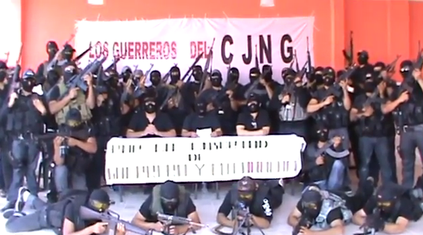
The war in Mexico between paramilitary drug-trafficking organizations and the government has shown the world how warfare is evolving.  With market-oriented technological advances, it’s possible for wealthy players to raise private armies.  It’s equally possible, and easy, for individuals to wage terrorist campaigns.


Jalisco New Generations Cartel declares war on the Knights Templar Cartel.
Nowadays, all it requires to be an insurgent is an AK-47, some explosives, and a laptop or tablet.  The words “terrorist” and “insurgent” are becoming synonymous as various “rebel” groups adopt both tactics at will.  Wars are being increasingly fought by non-state groups. Two examples are the separatist and nationalist militias in Ukraine, and the Kurdish guerrillas fighting ISIS in Syrian and Iraqi Kurdistan. Furthermore, the line between street gangs and organized crime syndicates is blurring.


The Mexican Drug War and other recent conflicts in show that gangs and highly organized criminal groups can also be rebel soldiers.


Take the Mexican cartels—commonly called drug gangs—once merely organized crime groups with street gang enforcers, now evolved into paramilitary organizations fighting the state and fighting rival paramilitary groups.  Their war has killed over 140,000 people in a decade.  This is called criminal insurgency.


Gang violence and organized crime activities have skyrocketed across Latin America, especially in Nicaragua, Honduras, and El Salvador.  The main combatants in the Central American gang wars are Mara Salvatrucha [MS-13] and Barrio 18 [18th Street or M-18].  Both transnational gangs serve as auxiliaries for opposing Mexican cartels. Their hired services include distribution, shipping, and armed enforcement operations.  Street gangs all over Mexico also work for one or another paramilitary drug-trafficking organization.


The ongoing civil war in Mexico—including its spillover across Latin America—is not the first instance of gangs and organized criminal groups fighting in modern wars.  Take the following examples:


  • In Mexico, 1910, Pancho Villa turned his bandit gang into a guerrilla army.
  • In China, bandit and warlord armies were absorbed into the Peoples Liberation Army in their fight against the Nanjing government.
  • The Vietnamese organized crime network Bin Xuyen openly fought the Saigon government and was absorbed into the Viet Cong.
  • Bandits and pirates joined demobilized anti-communist armies who formed paramilitary drug-trafficking organizations in Asia’s Golden Triangle.
  • Neighborhood gangs in Lebanon became overnight militias engaged in sectarian fighting.
  • In Colombia, the drug cartels partnered with the communist guerrillas to traffic drugs and fight the government.
  • The Iraqi insurgency in Fallujah included organized crime groups.
  • Today, the Taliban is financed in part by Afghan drug lords.


MS-13 foot soldier with a machine pistol
The United States has its own gang problem. Hundreds of thousands of people are members of local, regional, and national gangs.  According to Bunker and Sullivan, third-generation gangs (founded two generations ago) have the membership and logistical capability to resist the state.  Rather than battle over petty turf like first-generation local gangs, third-generation gangs have built up international trading networks, corporate-like hierarchies, and armed foot soldiers adequate for sustainable criminal insurgency.


Given the growing numbers, logistical capabilities, and sophistication of transnational gangs and local affiliates in the United States, alongside the growing numbers and militarization of America’s law enforcement agencies, it’s not unreasonable to suppose that a low-level armed conflict might arise between gangs and law enforcement agencies.  If a low-level armed conflict ensues, there is always the possibility of escalation.


There are libertarian solutions to alleviate a credible threat to national security like the one described above.


First, the Second Amendment must be respected by all levels of government in the United States.


Statistics have repeatedly shown areas with less restricted gun laws average less violent crime than areas under strict gun control.  The police can’t be everywhere, nor would free people want them everywhere, so the only solution for self-defense against gang violence is the right for citizens to bear arms.


Take Chicago, for example.  The city with some of the strictest gun control laws in the country is also the city with the highest murder rate in the country.  The majority of the 2014 Chicago murders were gang shootings.  Too many of those killed were bystanders, not participants in the violence.  The people of Chicago deserve to protect their persons, families, and communities.


Second, America’s prison system must shrink.


Prisons are illicit trading centers and recruiting centers for gangs at all levels.  As of 2008, 90.7% of federal prisoners were incarcerated for non-violent offenses.  As of 2011, 50% of federal prisoners were in for drug-related convictions.  Such a high level of non-violent offenders would prompt expanded parole, with a work-reparations plan if necessary.  Otherwise, non-violent offenders become “criminalized” by the violent prison culture.


Third, drug crimes constitute nearly half of federal inmates, the majority of them nonviolent; this points to one solution: end the federal war on drugs.


Better yet, legalize the victimless “crimes” for which nonviolent offenders are incarcerated.  Drugs, gambling, and prostitution are booming industries, and their illegality guarantees their domination by organized crime.  Rather than enabling racketeering for criminals, why not turn these industries over to law-abiding entrepreneurs?  Especially when their success must come from quality products and customer service, not coercion or monopoly through violence.


Homeland Security agents disembark from a MRAP vehicle
Fourth, law enforcement agencies must be demilitarized. There is no reason compatible with liberty for the Department of Agriculture to have submachine guns, nor is there any reason for local police departments to have armored personnel carriers.  If the public is faced with a military-grade threat, the states have National Guards who can respond appropriately .


Demilitarization of law enforcement reduces the chances of confrontation between law enforcement and criminal networks. Through legalizing drugs and other outlawed vices, major income sources leave the criminal underground for the free market.  By shrinking the prison system, gangs have far fewer recruit for their networks as non-violent offenders are paroled.


Criminal insurgency is a credible future threat to America's national security.  Through abiding by free market principles nationwide, and strict self-defense in times of emergency, this threat can be avoided and neutralized peacefully.


* * *


JNGC image taken from a YouTube screenshot from Wikimedia Commons via Fair Use.  MS-13 photo courtesy of the "Shooting From the Lip" Wordpress blog. Homeland Security paramilitary agents photo by DHS, obtained from "Stripers Online" forum, and in the public domain.