How War Destroyed Democracy in Athens
Zach Foster
Abstract: What does prolonged war do to a democracy of, by, and for the people? It kills the people and replaces democracy with rule by a small clique. This paper compares Pericles' vision of enlightened democracy with some of the Athenian atrocities in the Peloponnesian War and at home.
Thucydides' History
of the Peloponnesian War remains one of the most important books ever
written. It remains so not simply for
being the first history book written with scientific methodology, nor just for
being a thorough record of one of the most influential conflicts in world
history, but also because the narrative preserves a wealth of political ideas
of the day. The History offers readers a
glimpse at various competing political ideologies that, oddly, seemed to thrive
and wither away simultaneously. Thucydides'
narrative forever preserves various glimpses through time that reveal the
triumphs of political ideas in their societies, and also the times when ideas on
democracy and justice were twisted by war-weary populations who, in the name of
defending or enforcing said ideas, betrayed them. This is especially true of Athens, and the
evolution (or devolution?) of Athenian political ideas during the war will be
the main focus of this paper.
 One point of
confusion for many novice students of Thucydides is the constant inclusion of
dialogues, speeches, and elaboration of political ideas. They may wonder, What does this have to do with the war between Greek states? This issue is put into context by a Prussian
general who wrote, "...War is not merely a political act,
but also a real political instrument, a continuation of political commerce, a
carrying out of the same by other means" [emphasis added]; In
simpler terms, war is politics through organized violence (Clausewitz
1.24). This point adds fresh context to
the Athenians pursuing war as zealously as the Spartans.
One point of
confusion for many novice students of Thucydides is the constant inclusion of
dialogues, speeches, and elaboration of political ideas. They may wonder, What does this have to do with the war between Greek states? This issue is put into context by a Prussian
general who wrote, "...War is not merely a political act,
but also a real political instrument, a continuation of political commerce, a
carrying out of the same by other means" [emphasis added]; In
simpler terms, war is politics through organized violence (Clausewitz
1.24). This point adds fresh context to
the Athenians pursuing war as zealously as the Spartans.
One of the most famous political speeches of all
time is the funeral oration by Pericles, delivered at the close of the first
year of the Peloponnesian War, and a very trying year for Athens. It is easy enough to identify the signs of a
wartime speech, and the reader may find a delicate balance between the
nationalist overtones of the speech and a reverence for the war dead. The funeral oration could be compared to the
speeches delivered by President George W. Bush and numerous other American
politicians following the September 11, 2001 terrorist attacks. After a difficult year saturated with death
and destruction, Pericles finds it necessary to remind the downhearted
Athenians just what it is for which the fallen have fought.
"Our constitution does not copy the laws of
neighbouring states... If we look to the laws, they afford equal justice to all
in their private differences; if no social standing, advancement in public life
falls to reputation for capacity... nor again does poverty bar the way"
(Thucydides 2.37). Pericles not only
praises the pillars of Athenian democracy--constitutional law, equal rights for
citizens, merit-based advancement, etc.--but does so while comparing the
virtues of Athens to the un-democratic ways of her enemies. Pericles follows by praising and uplifting
the memory of the fallen. "Thus
choosing to die resisting, rather than to live submitting, they fled only from
dishonour, but met danger face to face... So died these men as became
Athenians" (Thucydides 2.42-43).
Pericles skillfully praises everything that makes Athens
"good" while comparing it all to the depredations that make her enemies
"evil."
Pericles also glorifies the dead for their courage,
and understanding their sacrifice at the moment in which it was made. Therefore, they are no longer soldiers killed
in war, hardly different from the fallen of the many other wars of antiquity,
but rather they are the heroes who make possible Athenian democracy. Pericles immediately follows this praise with
an exhortation of the public. The
Athenian public now has a responsibility to not only uphold the values for
which the soldiers died, thereby saving the sacrifices from vanity, but also to
continue the war. Explicit in the
exhortation is the public responsibility to pursue the war for democracy, and
implicit is the non-negotiable necessity for victory. These traditions and ideas expounded by
Pericles would seem to fade from the forefront as the war would drag on.
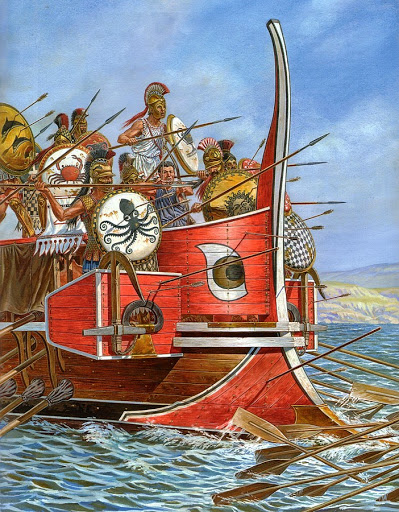
A decade of war changed attitudes among Athenian and
Spartan leadership. Thucydides describes
the major defeats suffered by Athens at Thessaly, Delium, and Amphipalis, thus
shaking the Athenians' confidence in their ability to win the war, all this
after years of refusing treaties. On the
other side, the course of the war showed the Spartans that this was not to be
the quick, easy victory for which they had hoped, and they were faced with the
danger of their confederacy dissolving and revolutions in their colonies
(Thucydides 5.13). The concessions made
during the peace essentially undermine everything for which the two sides had
fought. Both sides agreed to return
nearly all conquered territories. For
Sparta, which was not a democracy, the peace represents more of a military
defeat than a political one, as they simply lose conquered territories. For Athens, which was a democracy but also an
empire, much more is at stake. The
Athenian conquests represent new territories which would participate in
democracy and the amazing ways of daily life exclusive to Athens. Therefore, the Athenian cession represents
the conquered territories being deprived of the sublime gift of becoming Athenian. Furthermore, the terms of the peace treaty in
no way resemble the victory for which Pericles implicitly exhorts his
countrymen.
Prolonged war demonstrates a strange turn of events
by the sixteenth year of the war. The
Melian dialogue, between Athens and the leaders of Melos, stands out just as
sharply as Pericles' funeral oration.
The most noticeable difference in the context is that the latter deals
with democracy whereas the former deals with the ideas of justice, but both
have much to do with what is considered good and right. The Athenians spend the majority of the
dialogue trying to persuade the Melians to surrender their city to Athenian
occupation, the penalty for refusal being Biblical destruction. The Melians' arguments against Athenian
subjugation center around Melos' right to remain neutral in the war, despite
having paid tribute to Sparta as a colonial obligation (Thucydides 5.89-94).
The Athenian response to Melos: "As far as
right goes they think one has as much of it as the other, and that if any
maintain their independence it is because they are strong, and that if we do
not molest them it is because we are afraid; so that besides extending our
empire we should gain in security by your subjection; the fact that you are
islanders and weaker than others rendering it all the more important that you
should not succeed in baffling the masters of the sea" (Thucydides
5.97). To put it in plain language,
might makes right, and the might of the Athenian empire gives them the right to
subjugate smaller states. Democracy
technically favors the will of a majority over the will of a minority, and the
Athenian Greeks hold a numerical majority over the Melian Greeks, therefore
democracy could still be considered to be in practice during the impending
subjugation of Melos. However, the
"democratic" spirit prevalent in the Melian dialogue starkly contracts with the more enlightened,
gentler, more liberal version of democracy expounded by Pericles.

The culmination of Athenians' betrayal of democratic
ideals is displayed in Book 8 with the oligarchs' coup in Athens. In the very first year of the war, Pericles
exhorts his countrymen to pursue the war because the first year's dead fought
for sublime Athenian democracy. In the
twentieth year of the war, the coup of the Four Hundred immediately culminates
in a failed attempt to secure Persian support for Athens, in order to tilt the
balance of power against Sparta and perhaps bring a speedier end to the war
(Thucydides 8.49-54). The coup against
the democracy may be the greatest betrayal of Athenian ideals during the entire
war. Apart from the betrayal of
democracy, the oligarchs quickly sue for peace with Sparta, therefore
abandoning the crusade their countrymen had so long held to be noble. Without a doubt, the oligarchs were doing
what they believed was necessary to save Athens. However, in order to save Athens, they
abandoned the very system that made Athens exceptional.
Works Cited
Clausewitz, C. (author), Graham, J.
(translator). (1874 [1832]). On War. Project Gutenberg. Accessed 29
January 2014 from http://www.gutenberg.org/files/1946/1946-h/1946-h.htm#link2HCH0001
Thucydides (author), Crawley, R.
(translator). (1903 [411 BC]). The
History of the Peloponnesian War.
Cambridge: Massachusetts Institute of Technology. Accessed 29 January
2014 from http://classics.mit.edu/Thucydides/pelopwar.html
* * *
This paper is published online under the Creative Commonsa Attribution License 3.0: http://creativecommons.org/licenses/by/3.0/us/
Spartans in
battle sketch courtesy of Startanusm Wikispace. Athenian trireme and
marines painting courtesy of Igor Dzis. Thucydides bust photo and quote
courtesy of Rugusavay dot com. The images used on this page fall under fair use law and are not included in the CC BY 3.0 license.


.jpg/800px-Rand_&_Ron_Paul_(7150481755).jpg)
.gif)
