I'm Zach Foster and I'm blessed to be a man of many hats. This is the one room where you can look into all the different windows of my mind. Read on if you're ready to think outside the box! "Call it a character flaw -- when under attack, I counter attack. Always." --Richard Marcinko, Rogue Warrior
Opposing open borders in favor of strict border control, especially by means of the state, is antithetical to liberty. War is the health of the state, but the same can be said about strict border control, which requires the militarization of borders. If war is the health of the state, then militarized borders are also the health of the state. It takes a large, strong state to significantly and effectively shut down an international border.
Confused Trump-supporting libertarians are increasingly abandoning their laissez-faire and anarchist principles to rally around their standard-bearer and his red ball cap, ever ready to be cheerleaders for border security and militarization becoming the health of the state. Many of them love making the claim that open borders are a communist concept (referring to humanistic Marxism, rather than Marxist-Leninism). However, a simple study of history (read: reality, not political theory) will reveal that strict border controls is a virtue taken directly from the playbook of Marxist-Leninist and outright Stalinist regimes.
Shutting down open borders became important in the early twentieth century in Russia. The Red Army was still fighting the Whites, the Anarchists, and the bandit militias to control Russia and the nearby territories of the old Russian Empire. The Soviet government started a militarized corps of Border Guards after multiple foreign governments imported anti-communist guerrillas into Russia during their Civil War. The civil war in Russia even claimed the lives of over 400 US soldiers from American Expeditionary Force Siberia and American North Russia Expeditionary Force between 1918 and 1920...
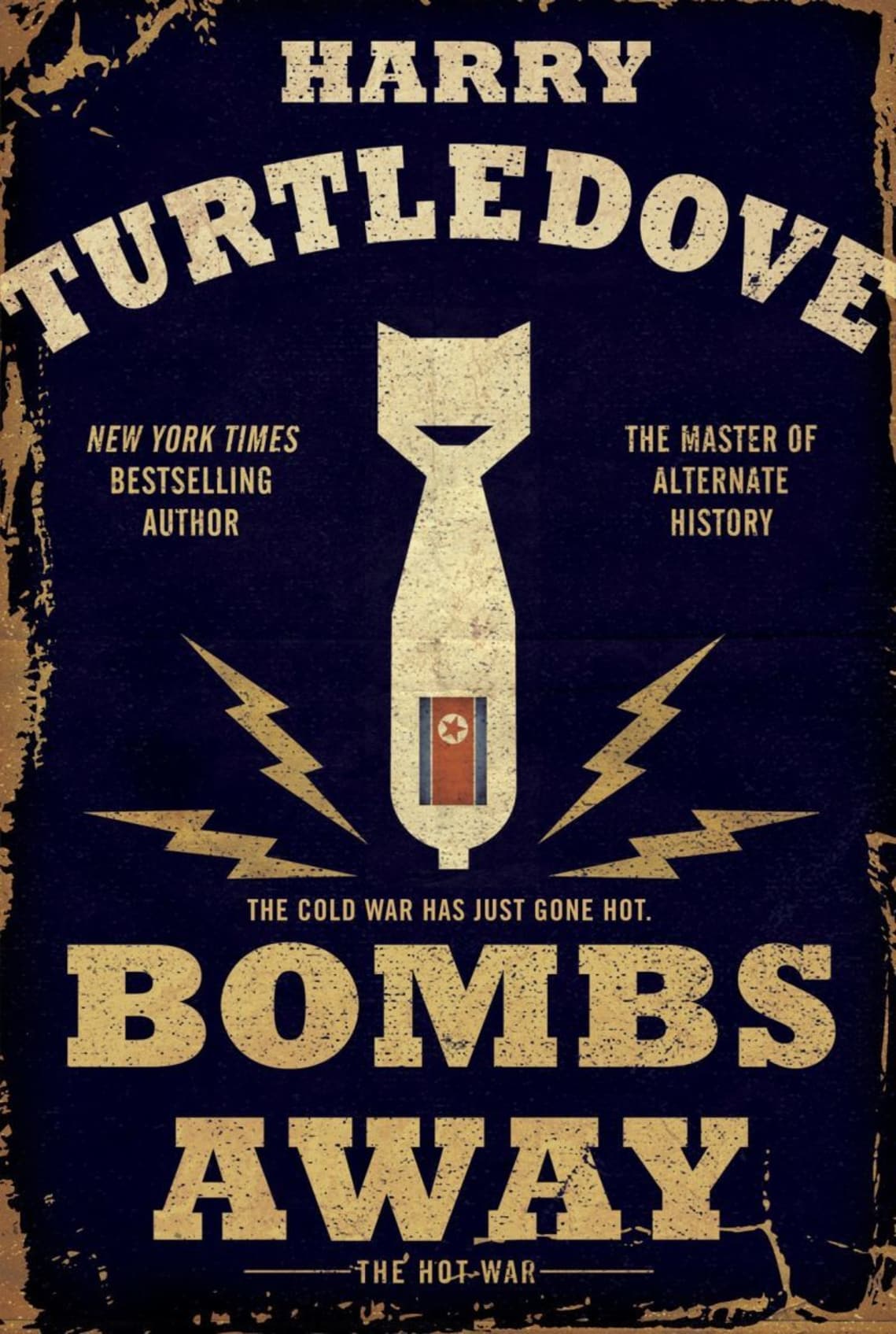
Harry Turtledove doesn’t identify as an alternate history writer, but rather as “a historian who writes science fiction.” Bombs Away isn’t quite what most readers would think of as science fiction, but this alternate history novel does deal a lot with the science of nuclear weapons, fallout, and contamination. Turtledove delivers another masterfully crafted novel that provides a frighteningly plausible picture of World War III, or when the Cold War turned Hot.
The novel begins in the early winter of 1950 in North Korea... Veterans of the war against Germany and Japan will be recalled to service; Germans who fought for Hitler will be called to their county’s “emergency militia”... (Read more)
I’ve been a fan of Harry Turtledove’s writing
ever since I picked up a copy of Great
War: American Front back in 2009. Turtledove has the ability to weave the
stories of numerous ordinary people together to make one large patchwork fabric
of an impressive, epic tale. Such is the
case with his 2015 novel, Joe Steele.
Joe
Steele is based on a short story of the same name
written in 2003, and expanded in 2014 to be a long, standalone novel. In this novel, the man who would become
Stalin is an American, a Democrat congressman from California rather than a
Georgian-born Communist Party bureaucrat in Russia. Born and raised among farm laborers in
Fresno, Joe Steele is a dedicated socialist and is militantly pro-labor.
The story follows the Sullivan Brothers, reporters both, over a twenty year period. One will unwillingly become a propagandist for the regime while the other is deported to a labor camp and must later fight on the front lines to atone for his political crimes. Our story begins at the height of the Great Depression.
When the nominating process at the 1932 Democratic
National Convention comes to complete gridlock between Franklin D. Roosevelt
and Joe Steele, no one knows who will challenge Herbert Hoover for the
Presidency. The sudden death of FDR in a
house fire leaves Joe Steele the uncontested nominee and the eventual landslide
victor over Hoover.
President Steele immediately begins a series of
economic reforms under the first Four Year Plan—an allusion to Stalin’s Five
Year Plan but tailored to the President’s term in office—with makes FDR’s New
Deal look like a children’s game. The
federal government begins confiscating property under eminent domain for
large-scale collective farming. The
Supreme Court justices who rule the new policies unconstitutional suddenly find
themselves in front of a military tribunal for a show trial, and promptly
sentenced to death by firing squad. Joe
Steele then moves on to purge the military establishment and key political
opposition (as well as purging loyal followers who pose a future potential
threat to the regime).
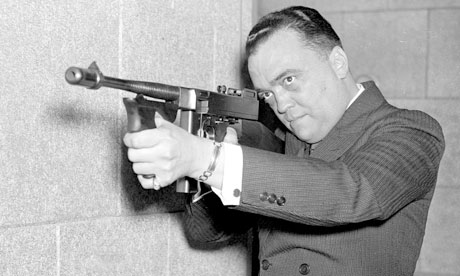
J. Edgar Hoover
J. Edgar Hoover also plays a prominent role in
the novel. Joe Steele’s second term is
when the Government Bureau of Investigation—an alternate-history play on the
FBI but resembling Stalin’s NKVD and later KGB—sets up a system of labor camps
in North Dakota, Colorado, and New Mexico where political prisoners work
themselves to death for “political reform.”
These are an obvious take on the true-history Gulag concentration camps
in the Soviet Union.
This novel shows America slogging through the
Great Depression, World War II, and the Cold War much the way it did in
true-history, but with the frightening tones of an endless Executive
dictatorship, one-party rule, and a police state. It’s frightening to watch Norman Rockwell’s
America descend into a totalitarian state.
While certain true-history events are changed—for instance, a ‘Japanese
War’ kicking off the Cold War instead of the Korean War, or Albert Einstein
refusing to design an atom bomb for Joe Steele—much of the novel is grounded in
truth.
For starters, Turtledove proves his expertise in
the field of U.S. history by using real case law from the Civil War that allows
the federal government to try civilians by military tribunal rather than by
jury trial. And while Americans may sleep
well today believing themselves safe from labor camps, current federal documents
tell a different story.
President Obama signed a series of Executive
Orders that essentially allow the federal government to create an America
similar to the version in Joe Steele.
Free speech is nothing but a privilege as long as Executive Order 10995
remains in effect, allowing the government to seize and control all
communication media. Natural resources
and utility companies aren’t safe from seizure while Order 10997 gives the
government carte blanche over all
electrical power, gas petroleum, fuels, and minerals.
A maximum security FEMA camp in Wyoming
Collective farms are made possible by Order
10999, giving the government authority to take over all farms and food
sources. Order 11004 gives the Housing
and Finance Authority the power to relocate communities, build new housing, and
transit large populations.
Even worse, labor camps are also made possible
by President Obama’s Executive Orders.
Order 11002 allows the Postmaster General to watch the entire population
by operating a national registration of all
persons. Order 11000 allows the
government to mobilize civilians into work brigades under government
supervision in times of war or peace.
After reading what the federal government currently has the power to do, does Joe Steele still look like pure
fiction? This novel is highly recommended
to any students of American and Soviet history, as well as anyone who values
liberty.
* * *
Joe Steele cover art courtesy of Turtledove Wiki. J. Edgar Hoover picture courtesy of The Guardian. FEMA camp image courtesy of Popular Mechanics. These images used according to Fair Use.
Last night I had the wonderful
opportunity to take my nephew to see Universal’s timeless classic, Frankenstein, on the big screen.It was a great time and we both enjoyed the
movie.I felt privileged by the fact that
both of us were seeing it for the first time in theaters, and that it was the
boy’s first time seeing an eighty-three year old masterpiece.
Seeing Boris Karloff as Frankenstein’s “monster”
for the first time in years had a powerful effect on me.With the limited audiovisual and special
effects capabilities of the time (1931), this movie is entirely driven by individual performance.Even Karloff’s almost-comical simplicity in portraying
the monster is driven by emotion and strong character acting.I could sense desperation both in the monster
and the humans who hate him.Beyond that,
the movie touched on my values, especially the sanctity of human life.
In Henry Frankenstein’s obsession with
creating life from dead tissue, he likens himself to God for giving life.This is the ultimate arrogance in a human
being, and such arrogance wreaks deadly consequences on the community once the “monster”
escapes.At first Frankenstein is
committed to preserving and cultivating the life he has artificially brought
into the world.Over a short amount of
time, Frankenstein’s monster proves to be beyond control, killing at least four
people in the creation’s short existence.
This image terrifies us deep down,
knowing that people’s final resting places were disturbed, their corpses violated
and mutilated without their consent.Even the dead have rights; this is something we recognize in people’s
final will and testament, by which their exact instructions for their persons
and property are enforceable by law.Living life in a world where people’s rights are violated every day, it’s
disturbing to think of our civil liberties and property rights being violated after
we pass on.Even worse is the idea of
your own corpse being used—without your consent—to create something that will brutally
kill innocent people.
Quite honestly, it was also very
uncomfortable to see the monster in its moments of despair and anguish.It’s known that the creature possesses an
abnormal (developmentally stunted and homicidal) brain and warrants his own destruction
by his deadly actions.At the same time,
the viewer knows this new life—while possessing some form of memory in its
formerly dead, damaged brain—knows next to nothing but torture.While it should never have been created—Frankenstein
had no right to do so—the creature is alive and awake.This new life enters the world and is kept in
shackles and darkness, a scene directly from Plato’s Allegory of the Cave.When the angry mob comes to destroy the
creature, this child-like life form will know fear, pain, agony, and true suffering.
The way Dr. Frankenstein degrades human
life to the subject of a science experiment reminds me of the ways governments are
run by men who play God with their citizens.The history of the world reveals numerous episodes wherein lives,
liberty and property were taken away, wherein people suffered and died, because
governments made grand experiments. These episodes are filled with lives and
fortunes destroyed via public policy.
Furthermore, nation-states like Nazi
Germany, the Soviet Union, and Red Cambodia are symbolic of monsters—created on
lofty ideals and mad delusions—out of control and causing untold death and
destruction.Moreover, the illusion
painted by governments, in which there is a monster lurking in the bushes, countless
times served as the justification for keeping citizens in a political state of
bondage.The recent NSA mass-surveillance
scandal is a painful indicator that our American Constitutional republic can
also slip into something decent people regard as evil.
Films like the 1931 adaptation of Mary
Shelley’s Frankenstein serve to
entertain audiences, in no small part through prompting an emotional response
(hence the inspiration for this review). Scary tales like this one serve as
powerful metaphors, ever reminding us of the sanctity of human life. They also remind
us to teach our children the value of life, and to respect that which does not
belong to us nor is ours to violate.
* * *
Universal Studios' photo of Boris Karloff as Frankenstein's monster is in the public domain and was obtained from Wikipedia.
Bundy Ranch standoff, conclusion I'm very grateful to everyone who took a stand on behalf of Mr. Bundy. I'm twice as thankful to the Almighty that, despite the high tension and potential for an armed clash, the protestors gave in to the better angels of their nature and kept the resistance PEACEFUL. -4/12
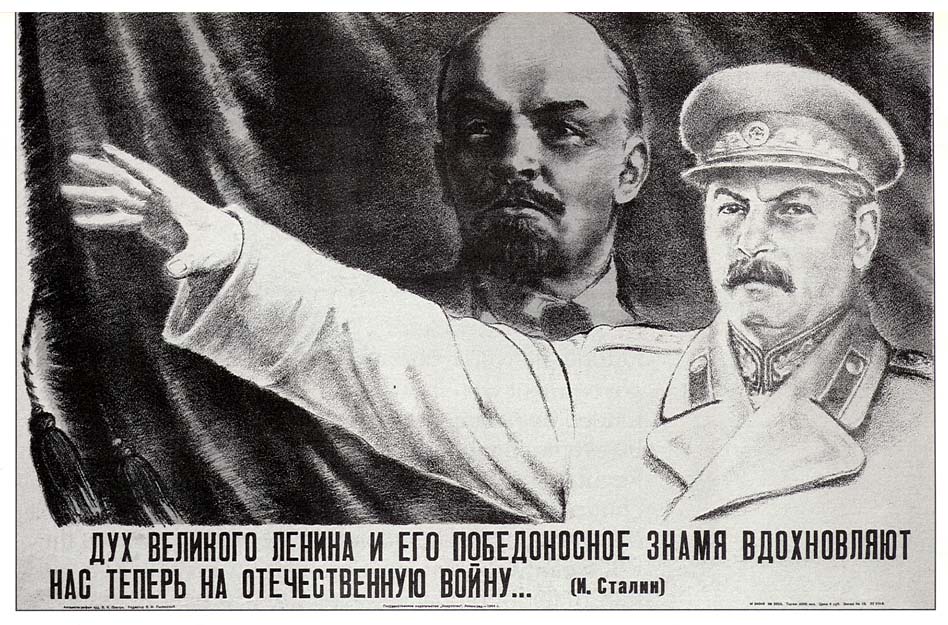
Lenin and Stalin I remember learning in high school about Lenin the revolutionary and Stalin the totalitarian dictator. The standard narrative suggests that Lenin was a visionary whereas Stalin was a barbarian who hijacked the Russian Revolution. In all reality, Stalin simply followed Lenin's bloodthirsty example and improved on it. -4/12
American politicians vs Japanese politicians When American politicians and CEOs majorly screw up, they get money, a free pass, and they look for another cushy job. When Japanese politicians and CEOs majorly screw up, they commit suicide to show their repentance and that they still have a shred of honor. Would that American voters and shareholders were so lucky... -4/15
Russian troops dressed as civilians Russian Special Forces dressed as civilian militants are taking over police stations in eastern Ukraine. Shots have been fired and Ukrainians have been killed. AT LEAST when the USA unjustly conquered Mexico and the Southern states, they had the courtesy to not pretend to be local "patriots". -4/17
The non-aggression principle There are days and there are people that truly test the non-aggression principle. It was said that blood alone moves the wheels of history, but a wise Rothbardian (named Murray) advocates attacking the method before attacking the man. Damn, this whole consistency-with-libertarianism thing ain't easy! (lol) -4/18
* * *
Stalin and spirit of Lenin poster by the Ukrainian SSR and in the public domain.
Russian troops with no insignia occupy Crimea, Feb. 28, 2014
Civil
wars in Ukraine
Nearly 100 years ago Ukraine had a civil
war to decide whether Ukraine would be an independent nation-state or join with
Soviet Russia. The Ukrainian Bolsheviks won the war and Ukrainian suffered in
the USSR. This time around, I hope the Ukrainian people unite to fully
emancipate from Russian influence and avoid fighting each other. –2/25
Three-sided
civil war in Syria
The Syrian Civil War has devolved into a
three-way war between the Syrian government (and Russian troops), the secular Syrian rebels, and
jihadists. The people of the Middle East need to approach future revolutions
with extreme caution because non-state groups will look for any openings they
can find for religious war. –2/27
Russian
invasion of Ukraine
Russian troops are on standby to enter
the Ukraine. If the Russians invade, Ukraine will surely spiral into civil war.
Just like in 1918, pro-Russians and pro-Western Ukrainians will fight over the
future of their country. Violent revolutions eat their children; for that, I'd
much sooner see Ukrainians lead a decade of peaceful reforms than suffer one
year of war. –2/27
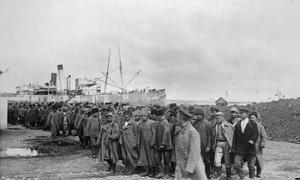
White Russians capture Bolsheviks in Kerch, Ukraine, 1919.
Russian
invasion commences
Yet again the Kremlin invades a neighbor
for housing individuals who want their country to be totally free of the Cold
War. –3/1
Secession
of Crimea
Russia is imposing the secession of
Crimea from the Ukraine via its army which invaded foreign territory. We
libertarians support self-determination for people who wish to secede, but not
when they're made puppets by invaders. Crimea's Ukrainians must vote whether or
not to secede in a plebiscite moderated by a neutral party. –3/3
* * *
Russian troops in Crimea photo by the U.S. Navy. Kerch 1919 photo from the Imperial War Museum Online Database. Both images are in the public domain.
I’m quite disappointed to realize I
never fully tackled the Alex Jones guest appearance on Piers Morgan’s
television program at the beginning of this year, so I’m taking this
opportunity to discuss something important.Whether they’re in favor of gun control or not, everyone who watched
that interview can clearly remember Alex Jones’ outburst and what he said:
“Hitler took the guns, Stalin took the
guns, Mao took the guns, Fidel Castro took the guns, Hugo Chavez took the guns
… 1776 will commence again if you try to take the guns from the American
people!!!”
While Jones’ point held an incredibly
valid argument, he unfortunately stated some tiredly overused rhetoric that
conservatives and libertarians use as an ideological defense of their Second
Amendment rights.To this very day,
leftists take the totalitarian argument completely out of context, and they’re
able to do so because conservatives and libertarians rarely ever add the proper
context to this valid argument.
Let me attempt to give a logical and
easy to understand explanation of what Jones meant.It’s overstated that the reason the Second
Amendment exists is for the American people to be able to protect themselves
from “tyrannical government.”That
statement in and of itself is incredibly vague and unclear in its meaning.What does “tyrannical government” exactly
mean?
This is what it boils down to: the
purpose of the Second Amendment is for the American civilian population to be
armed to be able to fight a war against the federal government.Plain and simple.
Battle of Lexington
Bear in mind that the Constitution and
its appendage, the Bill of Rights, were written and ratified less than a decade
after the American Revolutionary War had been won by the United States
government (formerly the confederated Continental governments).This war for independence began precisely as
an armed faction of the British citizenry in North America went to war against
the British government.The war began at
Lexington when a British Army battalion fired on the local militia, blatantly
violating what we understand today to be the rules of engagement.
The government fired on the citizenry
and the citizenry sure as hell shot back.
Many people on the left like to say that
the circumstances of the American Revolution were unique, and that the federal
government is not being tyrannical today the way the Crown was being.Not so!Anyone can take a look at the Declaration of Independence and see how
many of the grievances—especially those in the second half of the list of
outrages—written by the bipartisan Continental Congress in 1776 have been
repeatedly committed against the American people by the federal government,
under both the Bush and Obama administrations.
Some on the left may indeed agree that
the federal government is behaving the way the Royal Government behaved in the
1770s, but that our country’s government will never become as tyrannical as
Nazi Germany or the Soviet Union under Stalin.But how can they really be sure?
Let’s first look at the rise of the Nazi
regime in Germany.The infamous fire
that broke out in the Reichstag in February 1932 was the basis upon which
German President Paul von Hindenberg—a supporter of Adolf Hitler’s—issues the
Reichstag Fire Decree which was the “legal” basis for the German federal
government to nullify many key civil rights, including a protection against warrantless arrests, indefinite
detention, and seizures of personal property.
Adolf Hitler was elected in the spring
of 1933.Within one year of the seizure
of state power by the Nazi regime—by democratic means, no less—all Jewish-owned
businesses in Nazi Germany were marked with a yellow star or the word “Juden.”In 1935—two years into the Nazi regime’s
tenure—the passage of the Nuremburg laws stripped Germany’s Jews of their
citizenship (as well as various political targets and other undesirables).In 1936, special prison camps were built for
political prisoners.These prisons would
later be known as “concentration camps.”By 1938, the regime began
enforcing stringent gun control laws, confiscating as many firearms as
possible, and also began the mass incarceration of Jews into the newly built
camps.
The terror and horror was in full swing
within only five years.What amazes me
is how the majority of civil servants and elected officials in the German
government in 1932 were ordinary people, hardly different from those serving in
American government today.Is it still
completely implausible that tyranny could occur in America, creeping subtly to
the surface, within just five years?
Let’s look back even further at the
genesis of the Soviet Union.The
Bolsheviks occupied the Winter Palace in November 1917.Within a few months Lenin had dissolved the
Constituent Assembly (their at-the-time equivalent of a Congress or Parliament)
and outlawed the other political parties.Within two years of the October Revolution, Lenin organized the Cheka
(secret police) that was sixteen times as large as the Tsar’s secret
police.He ordered the arrest and
execution of at least 80,000 “enemies of the state” from the Social Democratic
and Socialist Revolutionary parties.
Many people assumed this madness was
simply part of the birth pangs of a new nation and part of the horrors of war
(Russia was in a civil war from 1918-22).However, it continued and progressively intensified.Lenin’s
regime did not only arrest the kulaks—landowners—but executed tens of thousands
of them.These figures do not reflect
the people that were forcibly deported from the young Soviet Union.
In 1924 Lenin passed away and Stalin was
selected by the Party to succeed him as Secretary.Within five years Stalin began his “Second
Revolution” to correct deviations from Marxist-Leninist doctrine which had
occurred during the Civil War and New Economic Policy (NEP), to eliminate the
new kulaks of the rising middle class which emerged during the first Five Year Plan
under the NEP, and to purge impure elements from the Communist Party.Though the Bolsheviks confiscated as many
civilian-owned firearms as possible during the Civil War, the Second Revolution
saw gun control officially implemented in 1929, immediately followed by a
nationwide campaign of firearms seizure by the government.
NKVD (precursor to the KGB) records testify
to 681,692 people executed during Stalin’s terror of 1936-39, though experts
put the number of people murdered by their government during this time at over
one million.Let it be understood that
when a government begins murdering its unarmed population, such a program is
called genocide.When a government
begins murdering its armed population, such is usually the initiation of a
civil war and likely government overthrow.Nonetheless, in Russia during the end of the Tsar’s reign and early
months of Bolshevik rule, just as in Germany, the majority of those serving in
government were ordinary people, hardly different from American government
employees and public servants.When the
regime began committing acts of tyranny, these same civil servants probably
believed they were doing the right thing, entirely for the public good, just as
the majority of the American Congress felt when they passed the PATRIOT Act and
the various versions of NDAA.
We’ve demonstrated that atrocities in
Germany began within five years of a change in government.The long list of atrocities in the Soviet
Union began within one year of the Bolsheviks taking power.Let’s ask ourselves, is it completely
implausible that a government could become tyrannical within one year?Even after the cases of Germany and Russia—ancient
lands steeped with rich histories and sophisticated culture—is it still impossible to consider that the
American government could inflict tyranny on its own citizens?
It is indeed possible, though I pray it
never happens.I love my country and I
consider my experiences so far in public service to have been an honor, but I
also realize that I—like all of you—must remain vigilant and protest whenever
the government oversteps its authority.I
fully understand that I’m 100 times more likely to be attacked by a fellow
citizen than by my own government, but as long as I practice my Second
Amendment right I can at least have a fighting chance to successfully defend
myself.I’m defenseless if the
government disarms me.
Returning to the Alex Jones shout-a-thon
on Piers Morgan’s show, it’s quite obvious that Piers set Alex up for that one.There was no table, after all, bringing the
two talking heads intimately close and thus making it more personal.As far as setting Jones up, Morgan succeeded
as Jones walked straight into the trap and began shouting.Once Jones commenced his tantrum, he’d
already lost and this victory for gun control advocates was broadcast
internationally.Because of that, it’s
my hope that shedding some light on the tyrannical government argument will
help my compatriots in the liberty movement present the argument accurately and
in context so as to make our pro-Second Amendment position understood, not
reviled.
Keep in mind and never forget that the
same brilliant statesmen who brought you the rights to free speech, due
process, and freedom from unlawful search and seizure are the same thinkers who
brought you the right to own firearms.They
did so in consideration of the U.S. government overstepping its authority and
attacking citizens, just as their government did in 1775.
* * *
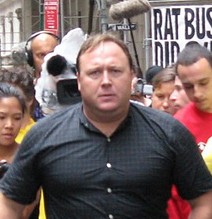
YouTube video contains footage that is the property of CNN but is used here in accordance with Fair Use Law and via Standard YouTube license. Alex Jones image used courtesy of "911conspiracy" and Piers Morgan image courtesy of Ian Lively. Both images hosted on Flickr, were obtained from Wikimedia Commons, and are used here via CC BY 2.0 license. The First Blow For Liberty, Battle of Lexington by A.H. Ritchie is in the public domain.




.jpg)